
Last Updated: October 26, 2026
Quick Summary
Choose weather resistant cushions by matching fabric, filling, and construction to your sun and rain exposure: solution-dyed acrylic resists UV fading best, while open-cell quick-dry foam lets water drain instead of soaking in. Ask whether the fabric is solution-dyed, check foam density, and confirm the finish is renewable, since water-repellent treatments wear away over time.
- Solution-dyed acrylic locks color into the fiber, so it resists UV fading far better than printed polyester.
- Water-resistant, water-repellent, and waterproof are three different promises that shoppers often treat as one.
- Open-cell foam drains and dries quickly, while closed-cell foam blocks water but traps heat.
- Clean cushions with mild soap, lukewarm water, and a soft brush, never bleach or a pressure washer.
- A 3-inch cushion suits occasional seating, but 4 to 5 inches holds up better for daily use.
Table of Contents
- What Weather Resistant Outdoor Patio Cushions Actually Need to Handle
- The Best Outdoor Cushion Fabric for Sun, Rain, and Everyday Use
- Waterproof Patio Cushions: What Water-Resistant, Water-Repellent, and Waterproof Really Mean
- Quick-Dry Outdoor Cushion Foam and Filling That Breathes
- How to Clean Outdoor Cushions Without Breaking Down the Fabric
- Fit, Thickness, and Comfort: Measuring Before You Buy
- Climate-Specific Cushion Choices for Desert Heat and Monsoon Rain
- Ordering Custom Weather Resistant Cushions from Molino Patio
- Frequently Asked Questions
What Weather Resistant Outdoor Patio Cushions Actually Need to Handle
Weather resistant cushions are built to resist sun fading, rain absorption, and mildew growth while staying comfortable enough to sit on every day. At Molino Patio, we’ve spent over 30 years watching what fails first in intense sun: the fabric fades, the foam soaks up water, and the seams give out. Most cushions marketed as “outdoor” handle one of those threats and ignore the others.
A cushion that only resists rain will still fade to gray in a season. One that only resists UV will turn into a sponge after the first storm.
So the real question isn’t “is this cushion weather resistant?” It’s “which weather does it resist, and for how long?” Below, we break down fabric, filling, construction, and fit so you can judge a cushion on all four.
The Best Outdoor Cushion Fabric for Sun, Rain, and Everyday Use
The best outdoor cushion fabric is solution-dyed acrylic, because the color is locked into the fiber itself rather than applied to the surface. That construction resists UV fading far better than printed polyester, which is why acrylic dominates the outdoor fabric market.
Here is how the main options compare on the criteria that actually predict performance:
| Fabric | Sun Resistance | Water Resistance | Breathability | Best For |
|---|---|---|---|---|
| Solution-dyed acrylic | Excellent | Good with treatment | High | Daily sun exposure, uncovered patios |
| Polyester (printed or piece-dyed) | Moderate | Moderate | Moderate | Covered patios, seasonal use |
| Vinyl-coated polyester | Good | Excellent | Low | Poolside, heavy rain, wipe-clean seating |
| Olefin (polypropylene) | Good | Good | High | Budget seating, humid climates |
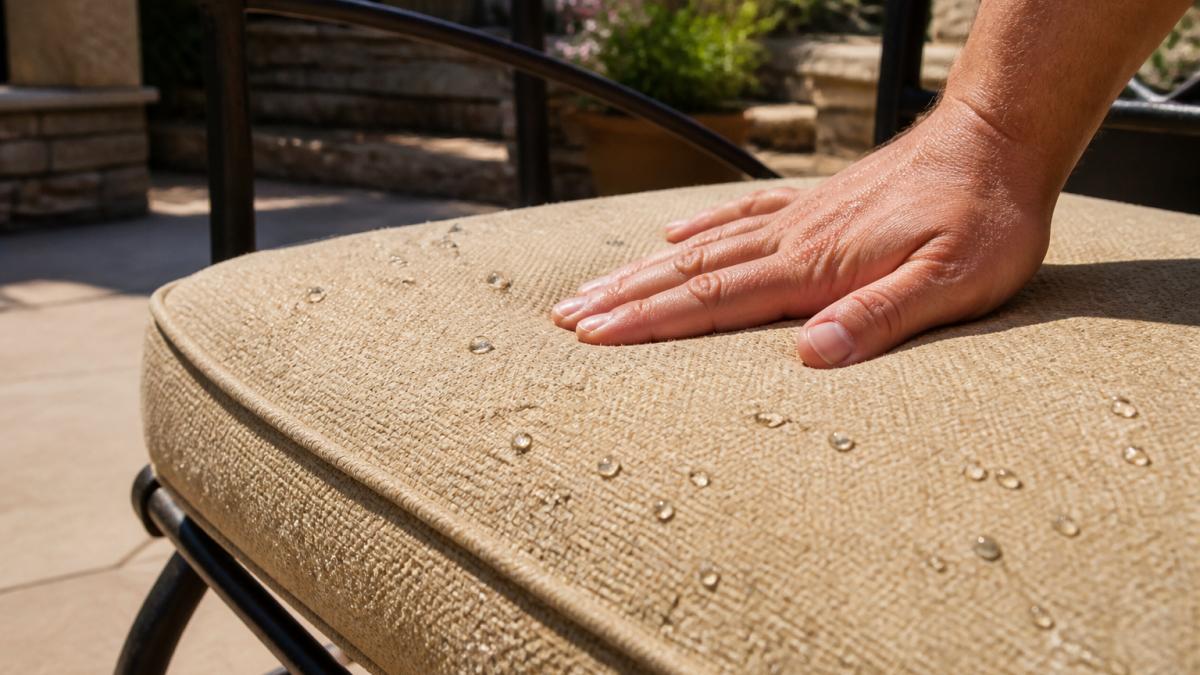
Why solution-dyed acrylic wins on fade. In solution dyeing, pigment is added to the polymer before the fiber is extruded, so the color runs through the entire cross-section.
Weave and weight matter as much as fiber. A tight, heavy weave sheds water and resists abrasion better than a loose, lightweight one. Fabric weight is usually expressed in ounces per square yard, and heavier outdoor fabrics generally resist pilling and seam stress better than lighter ones.
Finishes are temporary, not permanent. Water-repellent finishes are applied on top of the fabric and wear away with UV exposure, abrasion, and repeated cleaning. A fabric that beads water in year one may absorb it in year three unless the finish is renewed.
Backing and coating change the trade-off. A coated or laminated backing can block water, but it also blocks airflow. A cushion that cannot breathe holds moisture against the foam, which is exactly the condition mildew needs.
A common mistake is choosing fabric by color and pattern alone. Ask what the fiber is, how it is dyed, how heavy the weave is, and whether the finish is factory-applied or renewable. For a deeper comparison of durable cushion construction, see our guide on how to choose durable outdoor cushions.
Waterproof Patio Cushions: What Water-Resistant, Water-Repellent, and Waterproof Really Mean
Waterproof patio cushions keep water out completely, water-repellent cushions shed water off the surface, and water-resistant cushions slow absorption without stopping it. Those are three different promises, and most shoppers treat them as one.
- Water-resistant: fabric slows moisture penetration. Fine for light dew, not for a downpour.
- Water-repellent: a finish makes water bead and roll off. Better, but the finish wears over time.
- Waterproof: a barrier layer or coated backing blocks water entirely. Best for uncovered furniture.
Watch out: a waterproof cover over standard foam traps moisture inside once any water gets in through seams. Waterproofing only works when the filling and construction support it.
Quick-Dry Outdoor Cushion Foam and Filling That Breathes
Quick-dry outdoor cushion foam is open-cell foam, which lets water pass through the cushion instead of soaking into it. The open structure also lets air circulate, so the cushion dries faster after rain.
Compare the common fillings:
- Open-cell foam: drains and dries quickly, holds shape well
- Closed-cell foam: blocks water but traps heat and feels firm
- Fiber fill: soft and light, but clumps when wet and dries slowly
- Foam core with fiber wrap: comfort plus structure, the most common quality build
Foam density matters as much as foam type. A denser open-cell foam keeps its support longer instead of flattening into a pancake after a season of daily use. Ask for the density rating before you buy; a cushion that sags in year two wasn’t weather resistant, it was just cheap.
How to Clean Outdoor Cushions Without Breaking Down the Fabric
Cleaning outdoor cushions takes mild soap, lukewarm water, and a soft brush, and it should never involve bleach or a pressure washer. Harsh chemicals strip the water-repellent finish, and high pressure forces water past the fabric surface into the foam. But cleaning is only half of care.
Routine cleaning that protects the finish.
- Brush off loose dirt and debris when the cushion is dry.
- Mix a few drops of mild dish soap in a bucket of lukewarm water.
- Scrub gently with a soft brush, working with the fabric grain.
- Rinse with a garden hose on low pressure.
- Stand cushions on edge in the shade to dry fully before use.
Clean spills when they happen, and give cushions a full wash at the start and end of the season. Mildew prevention comes down to dryness: never store a damp cushion in a closed box. A cushion that stays damp for days is a cushion that will grow mildew, no matter how good the fabric is.
Realistic weather limits. Most outdoor cushion fabrics are designed to handle sun, dew, and occasional rain, but prolonged saturation, standing water, and freeze-thaw cycles shorten cushion life. A practical rule most practitioners follow: bring cushions in or cover them when heavy rain, hail, or freezing temperatures are forecast, and store them for the off-season rather than leaving them out through winter.
Drying time is a performance spec. Drying time depends on filling and construction, not just fabric. Open-cell foam and fiber-wrapped cores dry faster than closed-cell foam or thick fiber fill, and a cushion with drainage-friendly seams dries faster than one that pools water on top. After a soaking rain, stand cushions on edge with the seam side down so water can drain, and give them airflow on both faces.
Storage that does not undo the cleaning. Store cushions clean and fully dry, in a breathable bag or a dry, ventilated space. Avoid sealed plastic bins, which trap moisture, and avoid stacking damp cushions. For coastal patios, rinse salt spray off fabric and frames periodically, because salt attracts moisture and accelerates hardware corrosion. For humid climates, prioritize airflow and quick-dry filling over heavy waterproofing.
A simple test before storing: press the center of the cushion with your palm. If you feel cool moisture or the cushion stays compressed, it is not dry enough to store.
Weather-resistant cushions last longer when you treat the care routine as part of the purchase decision, not an afterthought. The best fabric in the world will fail if it stays wet, and the best filling will fail if it is cleaned with the wrong products.
Fit, Thickness, and Comfort: Measuring Before You Buy
Measure your existing cushions and your furniture frame before ordering, because a cushion that’s an inch too thick won’t sit right and one that’s too thin feels like a board. Record the width, depth, and thickness of the seat, plus the back height if you’re replacing back cushions.
Thickness drives comfort more than most buyers expect. A 3-inch cushion suits occasional seating; 4 to 5 inches holds up better for daily use and heavier guests. Measure the frame’s inner dimensions, not the old cushion, since old cushions compress over time. Our guide on how to measure a patio for furniture walks through the full process if you’re furnishing from scratch.
Climate-Specific Cushion Choices for Desert Heat and Monsoon Rain
Desert heat and monsoon rain demand different things from a cushion, and the best choice depends on which threat your patio faces most. In intense sun, UV fade resistance and heat tolerance matter most. In monsoon season, drainage and quick drying decide whether a cushion survives.
For sun-heavy exposures, solution-dyed acrylic and light color selection reduce heat buildup and fading. For monsoon exposure, open-cell foam, drainage-friendly construction, and water-repellent finishes keep cushions from staying soaked. Our article on why outdoor furniture fades in Arizona sun explains the fading mechanics, and our breakdown of the best patio furniture materials for sun compares frame options to pair with your cushions. If sun is your main enemy, these steps to protect outdoor furniture from sun are worth reading before the season starts.
Ordering Custom Weather Resistant Cushions from Molino Patio
Custom sizing solves the fit problems stock cushions can’t. At Molino Patio, we build custom cushions to your exact frame dimensions, so odd-shaped patios and non-standard seating get a proper fit instead of a compromise. Our cushions carry a 5-year warranty, and our frames carry a lifetime warranty.
For property managers and hospitality operators ordering in volume, we handle bulk orders with reliable delivery and installation. Financing is available interest-free for 90 days, and we offer price matching. We’re credited with the BBB and backed by authentic Google, Yelp, and Facebook reviews.
Pricing depends on size, fabric, and quantity, so request a quote for current numbers rather than guessing from a list.
Frequently Asked Questions
Are water-resistant and waterproof patio cushions the same?
No. Water-resistant fabric slows moisture absorption but can still soak through in steady rain. Water-repellent fabric makes water bead and roll off, though seams and zippers remain vulnerable. Waterproof cushions use a coated or laminated barrier that blocks liquid entirely, but they need sealed seams to work. For desert patios that see monsoon bursts, water-repellent covers paired with quick-dry foam usually balance protection and breathability better than fully waterproof shells.
What is the best filling for outdoor cushions?
Open-cell foam is the most practical filling for weather resistant cushions because water drains through the cells instead of pooling. High-density open-cell foam holds its shape and resists flattening, while fiber fill dries faster but compresses sooner. Look for foam that specifies outdoor use and a density rating; a wrapped foam core with a fiber layer on top gives support without trapping moisture. Avoid memory foam outdoors, since it absorbs water and dries slowly.
Can outdoor patio cushions be left outside in the rain?
Weather resistant cushions can handle occasional rain, but leaving them out through every storm shortens their life. Water-repellent fabric sheds light rain, yet seams and zippers let water in during heavy downpours. After a soaking, stand cushions on edge and let both sides air dry before use. In monsoon season, bring cushions inside or store them in a ventilated deck box when rain is forecast, and never stack wet cushions against each other.
How often should outdoor cushions be replaced?
With quality weather resistant cushions, expect three to five years of regular use before the foam flattens or the fabric fades noticeably. Cheap polyester covers in full sun may show color loss in one or two seasons. Cleaning regularly, storing cushions during harsh weather, and using quick-dry foam all extend life. Check for compression, mildew smell, or fabric thinning each spring; if the foam no longer springs back, replacement is due even if the cover looks fine.
The gap between a cushion that lasts two seasons and one that lasts ten comes down to fabric, filling, and fit, not luck. Molino Patio builds custom weather resistant cushions to your exact dimensions, backs them with a 5-year cushion warranty and lifetime frame warranty, and delivers and installs throughout Arizona. Get started with Molino Patio and furnish your patio with cushions built for the sun.

