
Table of Contents
- Outdoor Fire Tables: What Actually Matters Before You Buy
- Propane vs Natural Gas Fire Tables: Operating Costs and Setup
- How to Choose the Right Size Fire Table for Your Seating Area
- Outdoor Fire Table Safety Tips for Patios and Decks
- Materials, Finishes, and Shapes That Hold Up Outdoors
- Installation, Maintenance, and Seasonal Storage
- What to Ignore When Shopping for Outdoor Fire Tables
- Conclusion
- Frequently Asked Questions
Last Updated: October 8, 2026
Outdoor Fire Tables: What Actually Matters Before You Buy
An outdoor fire table is a low-profile gas or wood-burning unit built into a table-height surround that adds heat and light to a patio, deck, or backyard seating area, and doubles as a surface for drinks and plates.
Most shoppers compare finishes and photos, then discover the fuel hookup doesn’t reach, the table overwhelms the patio, or the frame pits after two summers. The real decision comes down to four things: fuel type, dimensions, materials, and maintenance.
Below, we break down operating costs, sizing math, safety clearances, and the specs most listings bury, plus what to ignore.
Buy for fit and fuel first, finish last. A perfectly matched fire table in a mid-tier finish outperforms an oversized showpiece that crowds your seating every single time.
Propane vs Natural Gas Fire Tables: Operating Costs and Setup
Propane and natural gas are the two practical fuel choices for a gas fire table, and the right pick depends on where the table sits and how often you light it. Propane runs from a refillable tank, so the table works anywhere on the property.
- Propane: No gas line needed. You swap or refill a tank, typically stored in an enclosure built into the table base. Best for renters, movable layouts, and patios far from a gas meter.
- Natural gas: Continuous fuel with nothing to refill. Requires a licensed plumber or gas fitter to run and connect the line. Best for permanent patios where the table will stay put.
- Wood-burning: Real flame and crackle, plus smoke, ash, and spark management. Only choose this where local rules allow open burning and you have clearance from structures.
Natural gas is generally cheaper per unit of heat, but the installation line adds upfront cost. Propane costs more per burn but carries no installation bill.
Natural gas produces a slightly softer, less yellow flame than propane. For a taller, more visible fire, propane with quality fire glass gives more drama.
Never store a spare propane tank inside the table enclosure or against the house. Tanks belong upright, outdoors, and away from heat sources. Storing one indoors or in an enclosed space is the single most common safety violation we see.
How to Choose the Right Size Fire Table for Your Seating Area
A rectangular or linear fire table suits a long sofa or a row of lounge chairs. A square or round table fits a conversation cluster of four to six. Here’s how the common shapes map to seating:
| Shape | Best For | Seating It Serves |
|---|---|---|
| Square | Compact conversation nooks | 4 people |
| Rectangular | Sofa and loveseat arrangements | 4-6 people |
| Round | Balanced, all-sides seating | 4-6 people |
| Linear | Long walls, pool decks, dividers | 6+ people |
Measure your patio’s usable footprint before you fall for a table online. A linear unit that looks elegant in a photo can swallow a small courtyard, while a modest square table can be perfect for a tight L-shaped patio.
Heat output matters too. A larger table spreads its flame across more burner area, a wider zone of warmth but a less concentrated one.
For odd-shaped patios, low overhangs, and tight corners, a custom-built table solves what stock sizes can’t. Have that conversation early, not after you’ve ordered the wrong footprint.
Outdoor Fire Table Safety Tips for Patios and Decks
Safety for an outdoor fire table comes down to four things: clearance, placement, ventilation, and supervision.
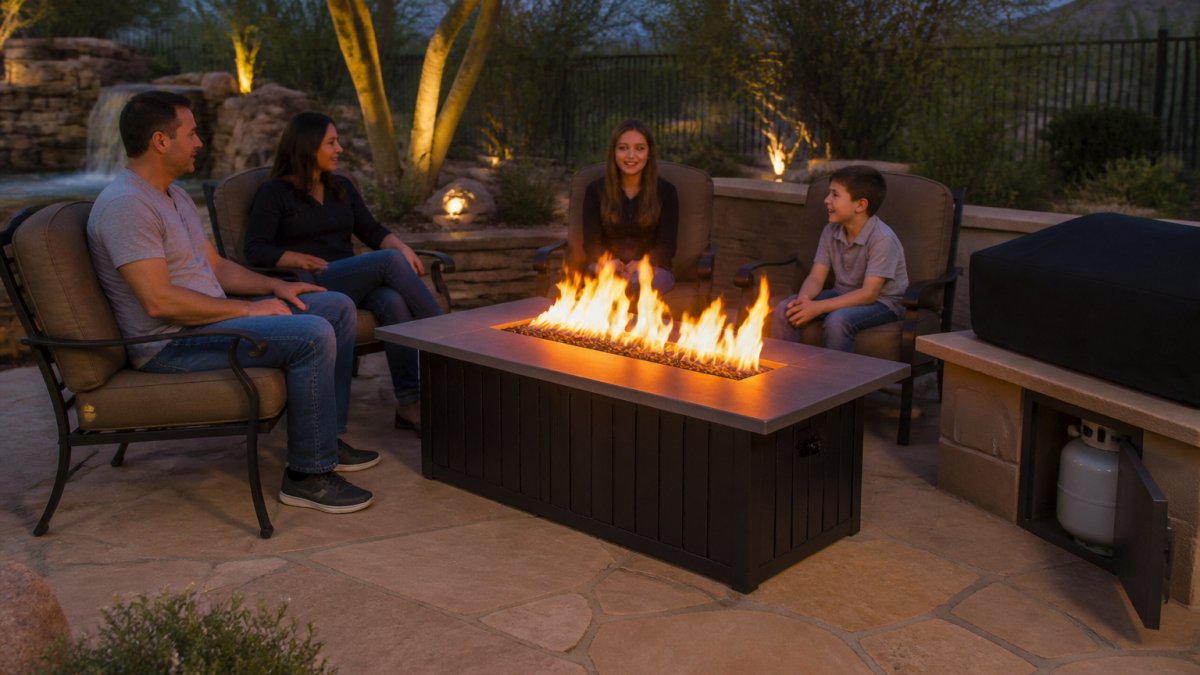
Start with the surface. A fire table belongs on a level, stable, non-combustible base, concrete, stone, or a rated paver system.
Then work outward and upward:
- Side clearance: Keep combustibles, cushions, throw blankets, wood railings, potted plants, and decor, well clear of the burner zone. A common working figure is at least 3 feet of clear space on all sides, and more on the side where people lean in.
- Overhead clearance: Never place a fire table under a roof, pergola, awning, or low tree canopy unless the structure is rated for it and the manufacturer allows it. Heat rises, and trapped heat is the failure mode that damages finishes and structures.
- Ventilation: Gas units need airflow. An enclosed or screened-in patio can trap combustion byproducts, so keep at least one side open to outside air and never run a table in a fully sealed space.
- Distance from structures: Keep the unit away from walls, fences, and the house itself. The exact number varies by manufacturer and by local code, so check both.
Before you buy, check three sources of rules:
- Your local fire code. Open-flame rules vary by jurisdiction, and some areas restrict burning on certain deck types or during burn bans.
- Your HOA or condo association. Many restrict open flame, fuel storage, and where a table can sit.
- Your manufacturer’s manual. It lists the clearances the unit was tested to, and those numbers override guesswork.
The NFPA fire safety resources publish general open-flame and outdoor heating guidance that’s a useful starting point, but it doesn’t replace your local code office.
A few habits prevent nearly every incident:
- Place the table on a level, stable, non-combustible surface
- Keep furniture, cushions, and decor clear of the burner zone
- Confirm overhead clearance before lighting under any structure
- Use a burner lid or cover when the table isn’t lit
- Install a windscreen on exposed, breezy patios
- Check the gas connection for leaks before first use each season
- Never move a lit table or a connected gas line
- Keep children and pets supervised around any open flame
- Keep a fire extinguisher rated for the fuel type within reach
Deck owners should pay extra attention: wood and composite decks have their own clearance expectations, and some jurisdictions restrict open flame on certain deck types. Confirm the rules for your property before you buy.
A windscreen does more than stop the flame from blowing sideways. On an exposed patio it also steadies the burn, which means the table heats more evenly and uses less fuel on a breezy evening.
Materials, Finishes, and Shapes That Hold Up Outdoors
Durability in outdoor fire tables comes down to three layers: the frame, the finish, and the burner media.
The frame. The structural material decides how the table ages:
- Powder-coated aluminum is the lightest common option and resists rust well because the coating is baked on rather than sprayed. It’s a good fit for humid climates and for tables you may want to move.
- Powder-coated steel is heavier and more rigid, and it holds a crisp edge on linear designs. It needs a clean, intact coating, any chip that exposes bare steel is where rust starts.
- Stainless steel resists corrosion best and is often used on the burner and hardware even when the surround is another material. Look for the grade; 304 stainless is the common outdoor standard, while 316 offers more salt resistance for coastal patios.
- Wrought iron delivers weight and a classic look, but it depends entirely on the quality of its finish to survive sun and moisture.
- Cast aluminum and cast concrete surrounds add mass and a stone-like look, but concrete is porous and should be sealed.
The finish. This is where cheap tables fail first. Look for UV-resistant or UV-stable finishes, and ask how the finish is applied, a properly cured powder coat or multi-step paint system outlasts a thin sprayed coat every time.
The media. Fire glass is the most common burner fill: it hides the burner, spreads the flame, and won’t produce the ash or embers of a wood fire.
Shape and finish should follow function:
- Contemporary and modern styles favor clean lines, linear burners, and neutral finishes that don’t compete with the landscape.
- Luxury and premium builds lean on heavier frames, stone surrounds, and finer detailing.
A burner lid keeps debris out when the table is off, and a fitted protective cover is the cheapest insurance you can buy for the finish. Both matter more than any decorative upgrade.
Spend your budget on the frame and finish first, then the media. A mid-tier table with a well-cured finish and a quality cover will outlast a premium-looking unit with a thin coat and no protection.
Installation, Maintenance, and Seasonal Storage
Installation and upkeep are simpler than most buyers expect, provided you plan the fuel connection first. A propane table needs only a level surface and a full tank. A natural gas table needs a licensed professional to run and connect the line, never DIY that step.
Maintenance is light but not optional:
- Weekly: Wipe the surface and check the burner for debris or insect nests.
- Monthly: Inspect the gas hose and connections for wear or leaks.
- Seasonally: Clean the burner ports and check the ignition system.
- Before storage: Disconnect the fuel, clean thoroughly, and cover the unit.
Weather protection is the difference between a table that lasts a decade and one that looks tired in three years. Use a fitted cover when the table isn’t in use, especially through monsoon season.
Warranty terms matter too. Ask upfront what’s covered, for how long, and what the claim process looks like. A clear, written warranty process beats a vague promise every time.
What to Ignore When Shopping for Outdoor Fire Tables
Ignore anything that doesn’t change how the table performs, fits, or lasts, flashy feature lists, oversized marketing claims, and finishes that look good in a photo but aren’t rated for exterior sun. The specs that matter are fuel type, dimensions, heat output, frame material, finish rating, and warranty terms.
A few things shoppers overweight:
- MSRP versus sale price. A deep discount on the wrong size is still the wrong table.
- Certification badges without context. Ask what standard applies, not just whether a logo appears.
- Burner size alone. A big burner with poor flame spread heats less evenly than a well-designed smaller one.
The cheapest path to a great fire table is matching it to your actual space and use. Buy for how you’ll live with it, not for the listing photo. If you’re unsure about sizing, fuel, or a custom footprint, ask a specialist before you commit.
Conclusion
Choosing an outdoor fire table is mostly a fit problem, not a shopping problem. Get the fuel type, dimensions, materials, and maintenance plan right, and the finish becomes the easy part.
At Molino Patio, we build outdoor furnishings to survive real sun and real seasons. Our fire tables come with a lifetime warranty on frames and a 5-year warranty on cushions, factory-direct and custom-made options, and interest-free 90-day financing. We also offer price matching and reliable delivery and installation, so the table you choose is the table that fits. Get started with Molino Patio and find an outdoor fire table built for your patio, not just your screen.
Frequently Asked Questions
Are outdoor fire tables worth the investment?
They extend patio use into cooler months and add a focal point for entertaining. The return depends on how often you use your outdoor space and whether the unit fits your seating layout. A fire table that is too large or too small for the area gets used less. Look for a frame warranty and a burner rated for the size of the table. Molino Patio offers a lifetime frame warranty and a 5-year cushion warranty on its outdoor furnishings.
What is the difference between propane and natural gas fire tables?
Propane fire tables run from a refillable tank, so they work anywhere on the patio without a gas line. Natural gas fire tables connect to a home gas line and never need refilling, but installation requires a licensed plumber and a permanent connection point. Propane costs more per unit of heat and needs tank storage, while natural gas is cheaper to run but less flexible if you rearrange the patio.
Can you put an outdoor fire table on a wooden deck?
Yes, if the deck is rated for the weight and you keep clearance from combustibles. Most manufacturers specify a minimum clearance from walls, railings, and overhead structures. A burner lid and a heat shield under the unit help protect the deck surface. Check local fire codes for any burn bans or patio rules before installing, and never place a fire table under a low overhang or enclosed roof.
How do you maintain an outdoor fire table?
Cover the table when not in use to keep rain and debris out of the burner. Clean the burner ports with a soft brush each season, check the gas connections for leaks, and replace fire glass or lava rock when it becomes discolored. In freezing climates, disconnect the propane tank and store it upright outside. A protective cover and a burner lid are the two accessories that extend the life of any fire table.
