
Table of Contents
- What Luxury Outdoor Furniture for Desert Homes Actually Requires
- Outdoor Furniture for Hot Climates: Materials That Hold Up
- UV-Resistant Outdoor Furniture: Fabrics, Finishes, and Fading
- Wrought Iron Patio Furniture: The Case for Metal Frames
- Desert Modern Outdoor Furniture: Styling Seating, Tables, and Layouts
- Desert-Specific Maintenance and Buying Guidance
- Frequently Asked Questions
Last Updated: October 18, 2026
What Luxury Outdoor Furniture for Desert Homes Actually Requires
Luxury outdoor furniture for desert homes is built to survive heat, ultraviolet radiation, and sudden temperature swings, not just to look good on a listing photo. At Molino Patio, we have spent more than 30 years building wrought iron sets, fire tables, and pergolas for Arizona yards, and the lesson repeats: what fails here is rarely the design. It is the material.
A standard patio set bought for a coastal climate meets a very different opponent in the desert. Below, we break down which materials hold up, how to plan shade and layout, and how to buy furniture you will still be using a decade from now.
Why Standard Patio Sets Fail in Arid Climates
Most mass-market patio sets are engineered for mild summers and regular rain. In arid climates, the failure points show up fast:
- Powder-coated steel frames that chip and then rust at the chip
- Foam cushions that trap heat and degrade from UV long before the fabric wears out
- Resin wicker that becomes brittle and cracks after a few seasons of intense sun
- Lightweight aluminum that shifts and rattles in gusty desert wind
A common mistake is assuming “outdoor” means “desert-proof.” It does not. The consumer product safety guidance from the U.S. Consumer Product Safety Commission on outdoor furnishings is a useful starting point for understanding what manufacturers are and are not required to disclose about weather performance.
Buying on looks alone is the fastest way to waste money in the desert. A set that photographs beautifully can still fade, crack, or overheat within two summers if the frame and fabric are not rated for high-UV, low-humidity conditions. Ask for material specifications before you buy.
Outdoor Furniture for Hot Climates: Materials That Hold Up
Outdoor furniture for hot climates should prioritize frame stability and heat resistance over decorative detail.
Here is how the main options compare across those stressors:
| Material | UV Performance | Surface Heat | Dust and Sand | Low Humidity | Best For |
|---|---|---|---|---|---|
| Wrought iron | Excellent with a quality powder coat or marine-grade paint; bare or chipped spots oxidize | Warms slowly, holds warmth after sunset; dark finishes get hot in direct sun | Dust sits on top and wipes off; grit can abrade coatings at joints | Stable; does not dry-crack | Permanent dining and lounge sets, wind-prone patios |
| Teak | Strong natural oils resist sun; silvers gracefully if untreated | Stays relatively cool to the touch | Dust lodges in grain; needs brushing | Stable; low shrinkage compared with softer woods | Loungers, dining tables, benches |
| Powder-coated aluminum | Good, but the coating is the weak point; chips expose bare metal | Light and quick to cool; thin walls can feel hot in direct sun | Lightweight frames shift in gusty wind; grit works into joints | Stable | Lightweight seating, balconies, movable pieces |
| Ductal concrete (ultra-high-performance concrete) | Excellent; mineral pigments resist fading | Absorbs and radiates heat; can stay warm well into evening | Dust settles in texture; sealed surfaces wipe clean | Stable; no drying or warping | Tables, fire features, plinths where weight is an asset |
| Woven wicker (synthetic HDPE or PVC) | Poor unless explicitly UV-stabilized; non-stabilized fiber becomes brittle | Varies by fiber; dark weaves absorb heat | Dust and sand lodge in weaves and are hard to remove | Can dry out and crack at flex points | Covered patios and shaded courtyards only |
| Natural stone (travertine, limestone, granite) | Excellent; no fading | High thermal mass; can be very hot in direct sun and slow to cool | Dust and sand are easily swept; porous stones stain | Stable | Table tops, flooring, accent pieces |
Wrought iron and teak are the workhorses. Concrete and stone suit tables and fire features where weight is an asset. Wicker earns its place only under shade.
A practical rule: match the material to the exposure. Fully exposed patios want wrought iron, teak, concrete, and stone. Covered patios can carry aluminum and UV-stabilized wicker. Pool decks want slip-resistant stone or concrete underfoot and quick-drying frames nearby.
In our experience, the finish matters as much as the metal. A quality powder coat or marine-grade paint on wrought iron will outlast a cheaper finish by years, especially on west-facing patios that take the harshest afternoon sun. Ask for the coating system and the cure process, not just the color.
UV-Resistant Outdoor Furniture: Fabrics, Finishes, and Fading
UV-resistant outdoor furniture depends on solution-dyed fabrics and UV-stabilized finishes, because standard dyes and coatings break down under intense sun. Fading is the most visible sign of failure, but it is rarely the first. Fabric loses strength before it loses color.
What to look for in cushions and upholstery:
- Solution-dyed acrylic or olefin, where color runs through the fiber rather than sitting on top
- Quick-dry foam that does not hold moisture after a rare desert rain
- Removable, washable covers so you can rotate and clean them
- UV-stabilized thread, since stitching fails before fabric does
For finishes, a UV-resistant topcoat on metal frames slows chalking and color shift. The U.S. Environmental Protection Agency’s UV radiation overview explains why exposure intensity varies so much by season and elevation, which matters if your patio sits at higher altitude.
Wrought Iron Patio Furniture: The Case for Metal Frames
Wrought iron patio furniture is the most reliable choice for desert homes that want a permanent, wind-stable set.
The catch is corrosion. Iron rusts where moisture collects, so the finish is everything. A properly coated wrought iron frame, maintained with occasional touch-ups, will outlast most alternatives. We build and finish frames to survive decades, not seasons.
If you are coming from a lightweight aluminum set, expect wrought iron to feel different. It is heavier to move, and it holds warmth longer after sunset. For a fixed dining or lounge arrangement, that trade-off is worth it.
Desert Modern Outdoor Furniture: Styling Seating, Tables, and Layouts
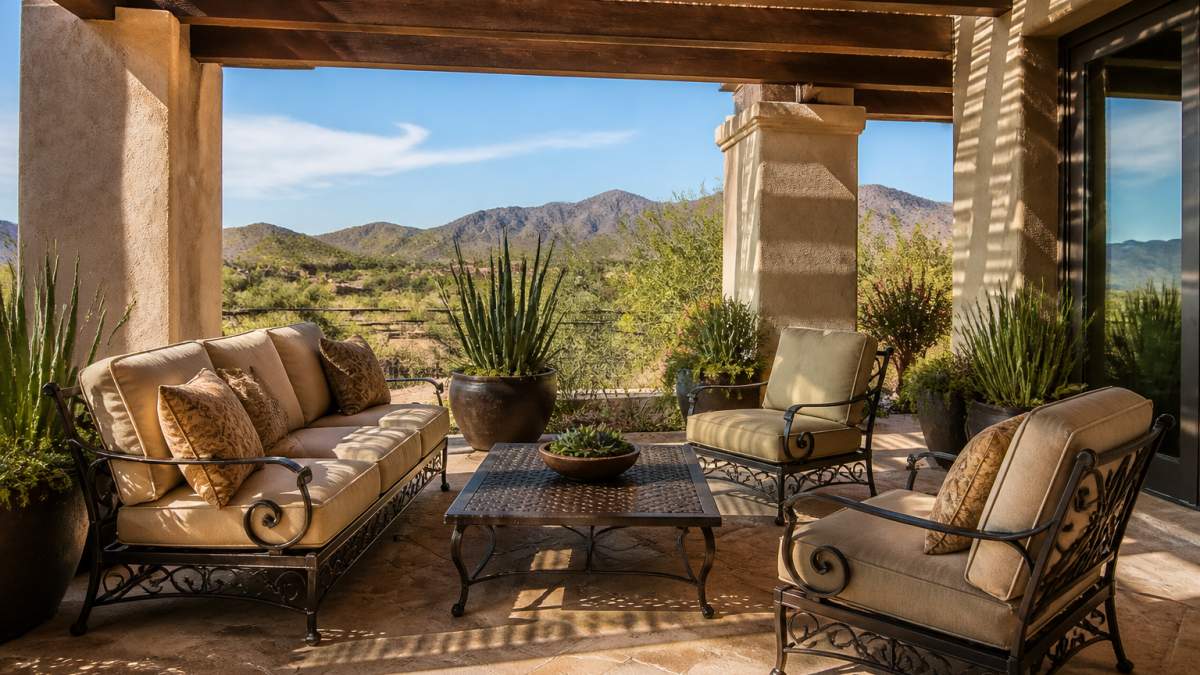
Desert modern outdoor furniture pairs clean lines with natural textures, and the goal is a space that feels cool and open even when the air is not. Layout matters as much as the pieces themselves.
Seating and Sofas for Courtyards and Terraces
Start with the shape of your space. An L-shaped courtyard wants a sectional or an L-arrangement of sofas and lounge chairs. A long terrace suits a linear dining set with a clear walkway. Keep sightlines to the view open, and group seating around a fire table or low table to anchor the arrangement.
For courtyards, a sofa plus two lounge chairs creates conversation without crowding. On open terraces, a dining table with matching chairs handles both meals and evening gatherings.
Shade, Surface Temperature, and Safe Usability
Shade is not decoration in the desert; it is a safety feature. A pergola, shade sail, or covered ramada lowers surface temperatures on furniture and makes seating usable in the afternoon.
Test surfaces before you commit to a material. Dark metal in direct sun can become uncomfortable to touch, while lighter finishes and natural wood stay cooler. Place the hottest surfaces, like fire tables and dark dining tops, where they get partial shade during peak hours.
The best desert patio plan combines shade, breathable materials, and a layout that keeps walkways clear. Get those three right and the space stays usable from morning coffee to late evening.
Desert-Specific Maintenance and Buying Guidance
Desert maintenance is mostly about dust and sun, not rain. A simple routine keeps furniture looking new and extends its working life, but the routine should follow the seasons rather than a generic checklist. Most guides treat maintenance as a single list; the useful version is a calendar plus a buying framework that ties price to expected service life.
Seasonal Maintenance Calendar
- Spring (dust season): Rinse or wipe frames monthly to remove dust that traps heat and abrades coatings. Brush cushions rather than soaking them, and let them air dry fully. Inspect welds, fasteners, and glides; grit works into joints and loosens hardware.
- Summer (peak UV and heat): Touch up any chip in a metal finish promptly to stop rust. Rotate and flip cushions so fading and compression are even. Store or cover cushions during the harshest months if the set is not in daily use. Check shade structures, fabric, seams, and anchors, before monsoon season.
- Monsoon (sudden rain): Confirm drainage on cushions and frames; quick-dry foam matters most here. After storms, dry frames and joints to prevent standing water in seams. Re-tighten fasteners that loosened in wind.
- Fall and winter (temperature swings): Clean and condition wood (teak oil if you want to preserve color; leave it to silver if you prefer the patina). Lubricate moving parts on umbrellas and recliners. Cover or store pieces that will sit unused through cold nights.
Cleaning, Cushion Care, and Lifecycle Value
- Rinse or wipe frames monthly to remove dust that traps heat
- Brush off cushions rather than soaking them, and let them air dry fully
- Touch up any chip in a metal finish promptly to stop rust
- Store or cover cushions during the harshest months if the set is not in daily use
- Inspect welds and fasteners each season
On buying, ask three questions: What is the frame material and finish? What is the cushion fabric and foam? What does the warranty actually cover? A lifetime frame warranty and a multi-year cushion warranty tell you the maker expects the product to last.
For commercial buyers, such as property managers or hospitality operators, bulk orders and custom sizing are worth discussing early. The Federal Trade Commission’s guidance on warranty disclosures explains what warranties must state, which helps you compare offers fairly. Ask whether the warranty covers finish failure, fading, and frame integrity separately, and whether it is prorated.
If your patio has an unusual shape or a low overhang, custom-built pieces usually solve the problem better than forcing a stock set to fit. Measure twice, sketch the layout, and bring the sketch to your consultation.
Frequently Asked Questions
What outdoor furniture materials hold up best in intense sun?
Powder-coated metal frames such as wrought iron, teak, and cast concrete hold up best in intense sun. Metal frames resist warping and, when powder-coated, resist rust. Teak develops a natural silver patina and resists cracking. Concrete stays cooler in shaded areas and handles heat without fading. Avoid untreated resin and thin aluminum, which can warp, chalk, or bend. Whatever you choose, confirm the frame warranty and ask how the finish is applied, since that is what decides how many summers it survives.
Is wrought iron a good choice for desert outdoor furniture?
Wrought iron is one of the strongest choices for desert patios. It is heavy enough to stay put in gusty winds, does not warp in heat, and can be shaped into custom designs for odd-shaped patios and low overhangs. The key is the finish: powder-coated wrought iron resists rust far better than painted steel. Wrought iron patio furniture also pairs well with breathable cushions, which dry faster after monsoon rain. Ask about frame warranties and touch up any chips quickly to protect the coating.
How do you keep patio furniture from getting too hot in the sun?
Place seating under a pergola, shade sail, or covered terrace so surfaces stay usable in the afternoon. Choose lighter cushion colors, since dark fabrics absorb more heat. Metal frames heat up faster than teak or concrete, so add seat cushions and avoid bare metal armrests in full sun. A simple test before buying: leave a sample in direct sun for an hour and touch it. If it is uncomfortable, plan shade over that piece rather than skipping it.
How should you arrange outdoor furniture on a desert patio?
Start with shade and sightlines. Put the main seating group where afternoon shade falls, facing the best view, and keep walkways clear of chair backs. On L-shaped or narrow patios, use a corner sofa with a low table rather than two facing sofas. Leave at least 18 inches between a table edge and the nearest wall or planter so chairs can pull out. Group dining separately from lounging, and anchor each zone with a rug or fire table to define it.
The desert is unforgiving to furniture that was never designed for it. If you are tired of replacing faded, rusting sets every few years, Molino Patio builds wrought iron, teak, concrete, and custom pieces specifically for intense sun, backed by a lifetime frame warranty, a five-year cushion warranty, and interest-free 90-day financing. Get started with Molino Patio and furnish a patio that holds up season after season.
