
Table of Contents
- Quick Comparison: Durable Weather Resistant Outdoor Dining Sets
- Best Patio Furniture Materials for Sun and Heat
- What to Look for in a Weather-Resistant Outdoor Dining Table
- How to Protect Outdoor Furniture from Sun Damage
- Assembly Difficulty Ratings and Repairability
- Climate-Specific Recommendations for Extreme Sun and Heat
- Warranty, Longevity, and Storage Protocols
- Frequently Asked Questions
Last Updated: October 9, 2026
Quick Comparison: Durable Weather Resistant Outdoor Dining Sets
Choosing durable weather resistant outdoor dining sets starts with the frame material, because that single decision determines how the set handles years of intense sun and heat.
Molino Patio has over 30 years of industry experience, so we know which materials survive and which ones fade, crack, or rust within a few summers. This guide breaks down the trade-offs so you can buy once and stop replacing patio furniture every two years.
Here is the short version before the details:
| Material | Sun & Heat Resistance | Maintenance | Best For |
|---|---|---|---|
| Powder-coated aluminum | Excellent, rustproof | Minimal | Most backyards, high-heat regions |
| High-density polyethylene (HDPE) | Excellent, fade-resistant | Minimal | Salt air, humid climates, busy households |
| Teak | Very good, needs re-sealing | Moderate | Covered patios, buyers who enjoy upkeep |
| Wrought iron | Good, needs touch-ups | Moderate to high | Traditional style, shaded areas |
Best Patio Furniture Materials for Sun and Heat
The best patio furniture materials for sun are powder-coated aluminum and high-density polyethylene, because both resist UV damage, rust, and warping without constant upkeep.
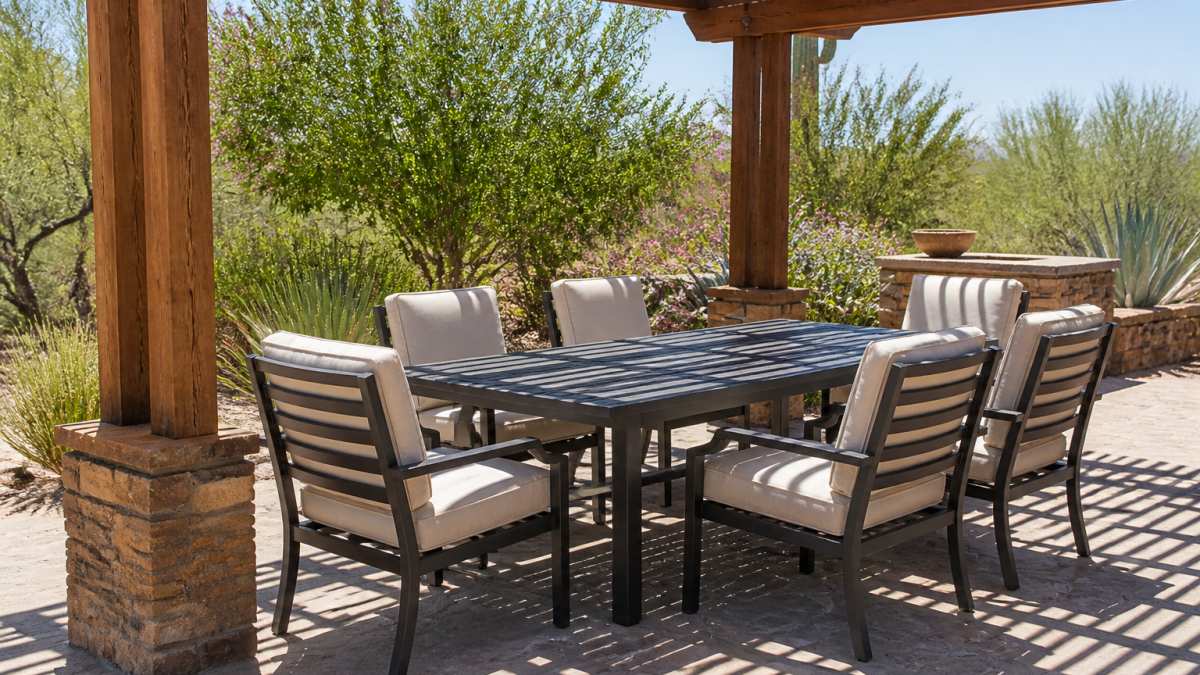
Material choice drives everything else: how often you clean, whether the frame stays rustproof, and how the cushions hold up. The U.S. Consumer Product Safety Commission guidance on outdoor products is a useful starting point for understanding how sun and moisture exposure affect consumer goods over time.
Powder-Coated Aluminum vs. Wrought Iron vs. HDPE vs. Teak
Each material earns its place for a different buyer, but the deciding factors are UV stabilization, coating thickness, and how the material behaves when it gets wet and then bakes in the sun.
- Powder-coated aluminum: Lightweight, rustproof, and corrosion-resistant. The powder coat is electrostatically applied and oven-cured, which is why it holds color far longer than wet paint. A common industry benchmark is a coating thickness in the 2 to 4 mil range; thinner coats chip and chalk faster. Aluminum itself will not rust, but it can pit in salt air if the coating is scratched through to bare metal, so touch up nicks promptly.
- High-density polyethylene (HDPE): A synthetic polymer made from recycled or virgin resin, colored through the material rather than painted on top. Because the pigment runs all the way through, a scratch does not reveal a different color underneath. HDPE is formulated with UV stabilizers that slow the chain-reaction breakdown sunlight causes in plastics; without them, the surface chalks and turns brittle. It will not crack in dry heat, does not splinter, and cleans with soap and water.
- Teak: A dense hardwood whose natural oils and tight grain repel moisture. Left alone, it weathers to a silver-gray patina that many buyers prefer; keeping the original honey tone requires periodic re-sealing with a teak oil or sealer. Teak is dimensionally stable, meaning it swells and shrinks less than softer woods, but it still needs to be kept off standing water to avoid mildew staining.
- Wrought iron: Heavy, stable, and traditional. Bare iron rusts quickly once moisture reaches it, so quality pieces rely on a primer plus a topcoat of paint. That paint is the rust barrier, and every chip or scratch is a future rust bloom. In humid or coastal air, expect to touch up the finish annually.
Ask for the powder-coat thickness and the UV-resistance rating before you buy. A thicker coat and a marine-grade finish are what separate a set that lasts a decade from one that chips in three summers. For HDPE, ask whether the resin is UV-stabilized and whether the color is molded through or applied as a surface coat.
How Each Material Fails (and How Fast)
Understanding the failure mode tells you what to watch for:
- Aluminum fails at the coating, not the metal. Chalking, fading, and chipping are the warning signs; the frame underneath is usually fine.
- HDPE fails at the surface when UV stabilizers are inadequate, showing as a chalky film and color fade rather than structural cracking.
- Teak fails at the surface too, but from neglect: unchecked moisture and dirt feed mildew, and unprotected wood grays unevenly.
- Wrought iron fails at any breach in the paint, where rust starts and spreads under the coating.
A set that matches your climate and your willingness to maintain it will outlast a more expensive set that does not.
What to Look for in a Weather-Resistant Outdoor Dining Table
A weather-resistant outdoor dining table should combine a rustproof frame with a tabletop that sheds water and resists heat buildup. Beyond material, check the dining capacity, ergonomic design, and how the set configuration fits your actual patio footprint.
The tabletop is where most buyers get tripped up, because the wrong surface gets uncomfortably hot in direct sun or traps water that damages the finish.
Tabletop Options: Slatted, Solid, and Glass
Each tabletop style solves a different problem:
- Slatted design: Gaps let rain drain and air circulate, so the surface dries fast and stays cooler. The best all-around choice for hot, wet climates.
- Solid surface: Smooth and easy to wipe down, but it can hold heat and pool water if it is not sealed properly.
- Glass: Easy to clean and visually light, but it shows dust and can get dangerously hot under direct sun.
Skip dark-colored solid tabletops in full sun. They absorb heat and can become too hot to touch, and the trapped moisture underneath speeds up finish failure.
How to Protect Outdoor Furniture from Sun Damage
Protecting outdoor furniture from sun damage comes down to shade, covers, and surface care, but the right protocol depends on whether your set faces dry desert sun, humid coastal air, or a four-season climate with hard freezes. Most guides give one generic list; the reality is that a set in Phoenix and a set in Miami need different routines to reach the same lifespan.
A few habits make a real difference:
- Rotate cushions and flip them so one side does not fade faster than the other.
- Rinse frames monthly to remove dust and pollen that hold moisture against the surface.
- Apply a UV-protectant treatment to hardwood and wrought iron as directed.
- Store cushions indoors during long stretches of extreme heat.
Climate-Specific Sun and Moisture Protocols
High-UV, low-humidity (desert and high-altitude): The threat is ultraviolet intensity and thermal cycling, not moisture.
High-humidity and salt-air (coastal): The threat is corrosion and mildew. Salt deposits hold moisture against metal and accelerate pitting, so rinse frames with fresh water after coastal exposure.
Four-season (freeze-thaw): The threat is water expanding inside joints, slats, and cushions. Any moisture left in a crevice can freeze, expand, and crack the surrounding material.
Cushion and Fabric Care
Cushion performance matters as much as the frame. Look for solution-dyed acrylic or similar fade-resistant, moisture-wicking fabrics, where the pigment is added to the fiber before it is spun rather than dyed after (Sunbrella Fabric Difference). That construction is why these fabrics hold color through years of sun. The American Cleaning Institute’s fabric care resources offers practical guidance on cleaning outdoor textiles without breaking down the fibers.
Storage and Winterization Protocol
Few guides spell out how to store a set for the off-season, but this is what protects the warranty and the finish:
- Clean and fully dry every surface before storing.
- Store cushions indoors in a dry, ventilated space, never in a sealed plastic bin.
- Cover frames with breathable covers, never plastic sheeting that traps moisture.
- Tighten bolts and inspect welds at the start of each season.
- Re-seal hardwood and touch up metal finishes before winter.
- Store the set off the ground if possible, so standing water cannot wick up into legs and joints.
Plastic tarps and sealed bins are the most common storage mistake. They trap condensation against the frame and cushion, which is exactly what causes rust, mildew, and the musty smell that never comes out.
The single highest-return habit is drying everything completely before it is covered or stored. Sun damage is gradual, but moisture damage during storage can ruin a set in one off-season.
Assembly Difficulty Ratings and Repairability
Assembly difficulty varies widely by material and design, and repairability is the factor most buyers ignore until something breaks. Aluminum and HDPE sets are usually the easiest to assemble and the simplest to repair, while wrought iron and teak demand more patience.
Here is how we rate the common setups:
| Setup | Assembly Difficulty | Repairability | Notes |
|---|---|---|---|
| Aluminum, pre-welded frame | Low | Easy | Bolt-on parts, replaceable hardware |
| HDPE | Low | Easy | Modular panels swap out individually |
| Teak | Medium | Medium | Re-sealing and sanding restore the surface |
| Wrought iron | Medium to high | Moderate | Welds and paint touch-ups needed over time |
Buy sets with replaceable hardware and modular components. When a single chair or tabletop can be swapped instead of the whole set, the furniture lasts far longer.
Climate-Specific Recommendations for Extreme Sun and Heat
In extreme sun and heat, powder-coated aluminum and HDPE outperform every other material, because neither rusts, warps, or fades quickly.
This is the angle most buying guides skip. A set that thrives in a mild coastal climate can fail fast in a desert backyard where surface temperatures climb far higher.
For humid or coastal areas, focus on rustproof and corrosion-resistant frames, since salt air attacks metal quickly.
Warranty, Longevity, and Storage Protocols
Warranty terms and storage habits decide how long a set actually lasts, not just how it looks on delivery day. A strong frame warranty protects your investment, and proper winterization prevents the damage that shortens a set’s life.
Look for a lifetime warranty on frames and a multi-year warranty on cushions, and read the claim process before you buy.
Storage and winterization protocols:
- Clean and fully dry every surface before storing.
- Store cushions indoors in a dry, ventilated space.
- Cover frames with breathable covers, never plastic sheeting that traps moisture.
- Tighten bolts and inspect welds at the start of each season.
- Re-seal hardwood and touch up metal finishes before winter.
Breathable covers beat plastic tarps every time. Plastic traps condensation against the frame, which is exactly what causes rust and mildew during storage.
Frequently Asked Questions
What is the most durable material for an outdoor dining set in intense sun and heat?
Powder-coated aluminum and high-density polyethylene (HDPE) hold up best in extreme sun. Aluminum resists rust and won’t crack, while HDPE is fade-resistant and splinter-free. Wrought iron is heavy and sturdy but requires re-sealing to prevent rust. Teak weathers well but needs periodic oiling. For desert climates, powder-coated aluminum frames with UV-resistant cushions offer the best balance of low maintenance and long-lasting performance.
How do I protect my outdoor dining set from fading and sun damage?
Use a fitted cover when the set is not in use, especially during peak UV hours. Apply a UV-protectant spray to fabric cushions every few months. For metal frames, touch up scratches with matching paint to prevent corrosion. Consider a pergola or shade sail to reduce direct exposure. Rotate cushions and store them in a dry area during extreme heat waves. These steps help preserve color and structural integrity.
Can I leave my outdoor dining set outside all year long?
It depends on the material and your local climate. Powder-coated aluminum, HDPE, and marine-grade materials can stay outside year-round in most conditions. However, intense sun and monsoon seasons can degrade cushions and finishes over time. For maximum longevity, use a cover during off-seasons and bring cushions inside during heavy rain or dust storms. Regular cleaning and occasional re-sealing extend the life of any set.
How difficult is it to assemble a durable outdoor dining set?
Assembly difficulty varies by design. Most aluminum and HDPE sets come with pre-drilled holes and clear instructions, requiring only basic tools like a screwdriver and wrench. Wrought iron sets may be heavier and need two people. Some brands offer white-glove delivery and assembly. If you prefer a hassle-free setup, look for sets that arrive fully assembled or include installation services. Always check the product manual for estimated assembly time.
A durable set should still look sharp after a decade of punishing sun, and that is the standard we build to at Molino Patio. We back our wrought iron and custom-made pieces with a lifetime warranty on frames and a 5-year warranty on cushions, offer factory-direct and custom-built options, and provide interest-free 90-day financing plus reliable delivery and installation. Get started with Molino Patio and furnish an outdoor space built to handle the heat for years.
