
Last Updated: October 25, 2026
Quick Summary
Custom sun shades are worth the investment when standard shade keeps failing you, the umbrella that tips in wind, the fabric that fades by August, or the shade that leaves half your seating exposed. If you use the space daily and have already replaced cheap shade more than once, custom shades usually win on coverage and lifespan.
- A standard shade in intense sun often needs replacing every season or two.
- Custom shades cost more upfront, take longer to order and install, and are not portable.
- Compare annual cost over the years you expect to own the shade, not upfront price alone.
- Molino Patio backs frames with a lifetime warranty and cushions with a five-year warranty.
- Planning starts with measuring the space and mapping where direct sun lands through the day.
Table of Contents
- When Custom Sun Shades Are Worth the Investment
- Custom vs. Standard Patio Shades: What You Actually Pay For
- Outdoor Shade Sail Pros and Cons
- The Cost of Custom Outdoor Shades and Long-Term Return
- Outdoor Shade Fabric Durability in Intense Sun
- Roof and Side-Window Shades vs. Windshield Shades
- Trade-Offs Beyond Fit: What Custom Shades Won’t Solve
- Planning a Custom Shade Solution for Your Space
- Frequently Asked Questions
When Custom Sun Shades Are Worth the Investment
Custom sun shades are worth the investment when standard options keep failing you: the umbrella that tips in monsoon gusts, the fabric that fades by August, the shade that leaves half the seating area exposed at 4 p.m.
Below, we break down the seven signs that tell you it is time to stop replacing cheap shade and start investing in a solution built for your space.
The first sign is simple: you have already bought shade twice. A universal-fit car sunshade or a discount patio umbrella rarely survives more than a season or two in intense sun. When you are replacing the same item every year, the cheap option is no longer cheap.
The second sign is fit. A shade that does not match your opening, your roofline, or your seating layout leaves gaps where the sun hits hardest. If you have ever moved furniture mid-afternoon to chase a shadow, that is a coverage problem a custom solution can solve.
Custom vs. Standard Patio Shades: What You Actually Pay For
Custom vs. standard patio shades is really a question of what you are buying. With a standard shade, you pay for a mass-produced product built to fit an average space.
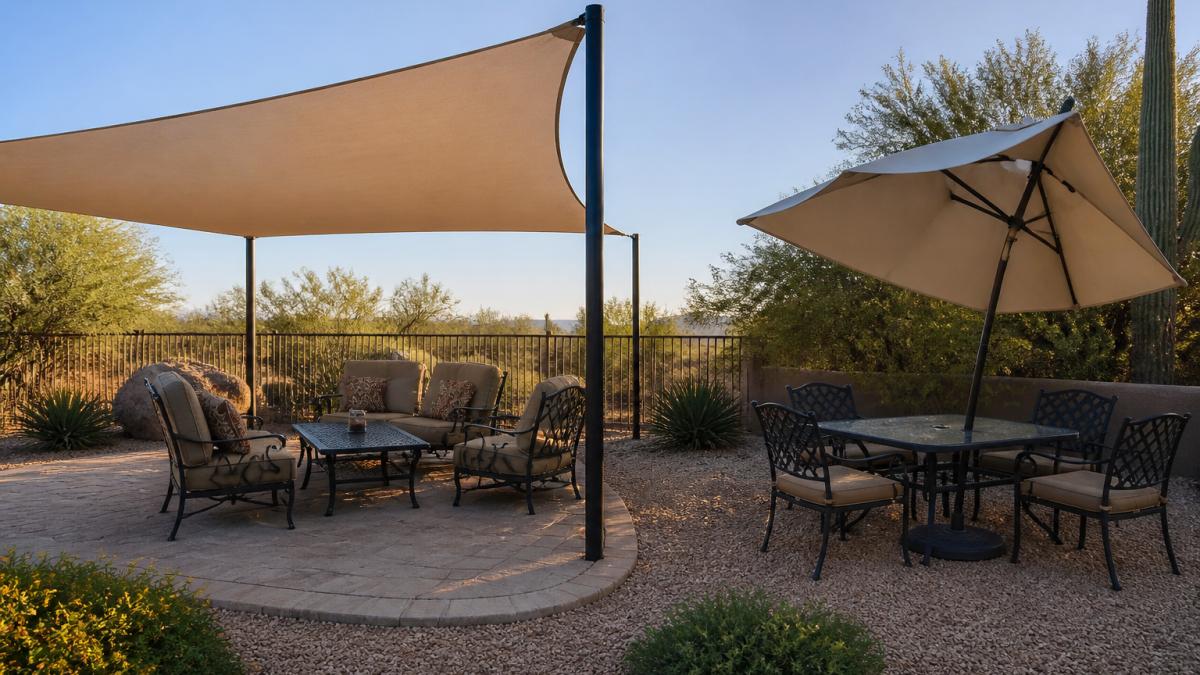
Fit and coverage. A standard umbrella or big-box shade is sized to common dimensions, so it rarely covers the full seating area you actually use.
Materials and construction. Standard shades typically use commodity fabric and hardware chosen to hit a retail price point.
Installation and effort. A standard umbrella or pop-up shade goes up in minutes but needs re-adjusting, re-weighting, or re-staking as wind and sun move it around.
Storage and portability. Standard shades fold down and store in a closet or garage, which is a real advantage if you rent, move frequently, or need shade only occasionally.
Lifespan and replacement cadence. A standard shade in intense sun often needs replacing every season or two.
What most buyers miss is that a custom shade is not just a nicer version of the same product.
Custom shades win on fit, coverage, and lifespan; standard shades win on upfront price, portability, and speed. The right choice depends on how often you use the space and how long you plan to stay.
Here is how custom and standard patio shades differ across the factors that matter most.
| Factor | Standard shade | Custom shade |
|---|---|---|
| Fit and coverage | Sized to common dimensions; gaps at edges | Measured to your opening, roofline, or layout |
| Materials and construction | Commodity fabric and hardware chosen to hit a price point | Solution-dyed acrylic or UV-stabilized fabric, reinforced seams, corrosion-resistant hardware |
| Installation and effort | Goes up in minutes but needs re-adjusting and re-weighting | Installed once, tensioned correctly, anchored to structure |
| Storage and portability | Folds down and stores in a closet or garage | Semi-permanent or permanent; not portable |
| Lifespan and replacement cadence | Often needs replacing every season or two in intense sun | Built to last years with durable materials and a warranty |
Outdoor Shade Sail Pros and Cons
Outdoor shade sail pros and cons come down to tension and coverage. A shade sail is a tensioned fabric panel anchored to posts or a structure, and it works well when it is engineered for the span and the wind load. It fails when it is treated as a decorative add-on.
The pros are real. Sails handle large spans, let hot air escape, and can be positioned to block the harshest afternoon sun without walling off the space. They look clean and modern over a seating or dining area.
The cons are equally real. A sail needs solid anchor points and correct tension, or it sags and flaps. Cheap hardware rusts. Fabric that is not rated for intense UV will degrade faster than you expect.
If your patio has low overhangs or an irregular shape, a tensioned sail may not be the right tool. That is where a custom pergola or a fitted fabric structure often wins.
The Cost of Custom Outdoor Shades and Long-Term Return
The cost of custom outdoor shades depends on size, materials, hardware, and installation, so there is no single number that fits every space.
What drives the price. Four factors move the number most:
- Size and span. Larger spans need stronger frames, more fabric, and more anchor points. A small window awning and a full patio structure are different categories of purchase.
- Fabric grade. Commodity fabric versus solution-dyed acrylic or UV-stabilized material changes both the upfront price and the replacement cadence.
- Hardware and anchoring. Posts, brackets, tensioning systems, and corrosion-resistant fasteners are a meaningful share of the total, especially where wind load is a factor.
- Installation. Site prep, mounting surface, and whether the structure is freestanding or attached all affect labor.
A framework for return. Rather than quote a single price, compare the custom shade against the replacement cadence of the cheap option you are already buying. If a standard shade costs less upfront but needs replacing every season or two, the spending never stops. A custom structure spreads its cost across years of use.
What the return does not include. Be honest about the limits. A custom shade does not eliminate interior or furniture wear, does not cool an oven-hot patio on its own, and does not add resale value in every market. The return is mostly in avoided replacement, better coverage, and comfort, not in a guaranteed dollar figure.
Warranty and support. A real warranty changes the math. For a concrete sense of what a comparable structure runs, you can request a custom pergola installation cost estimate before you commit.
Do not compare a custom shade’s upfront price to a standard shade’s upfront price alone. Compare annual cost over the years you expect to own it, and include the labor of re-installing and re-adjusting the cheap option.
Outdoor Shade Fabric Durability in Intense Sun
Outdoor shade fabric durability is the single biggest factor in whether your investment holds up. In intense sun, fabric faces a constant test: UV radiation breaks down fibers, heat stresses seams, and dust and monsoon grit wear the surface.
The fabrics that last are chosen for the job. Solution-dyed acrylics and UV-stabilized materials hold color and strength far longer than untreated canvas or cheap polyester. Construction matters too: reinforced seams, proper tension, and hardware that does not corrode keep a shade performing season after season.
Watch out: the most common mistake is buying on color and price alone. A fabric that looks right on day one can fade, sag, or tear within a couple of summers. Ask what the fabric is rated for and how the shade is tensioned before you buy.
If your structure is already up, our guide on maintaining outdoor pergolas in Arizona heat covers the upkeep that keeps fabric and frames in shape.
Roof and Side-Window Shades vs. Windshield Shades
Roof and side-window shades and windshield shades solve different problems, and confusing them leads to disappointing results. A windshield sunshade blocks direct sun through the front glass, which cuts glare and protects the dashboard. Roof and side-window shades address the larger surface area where heat builds: the roof and the side glass that let sun pour in all day.
For a vehicle, a custom-fit windshield sunshade that matches the exact shape of your glass gives far better windshield coverage than a floppy universal-fit version. For a patio or pergola, the same logic applies at a larger scale: roof coverage does the heavy lifting, and side shading closes the gaps where low sun sneaks in.
The takeaway is to match the shade to the exposure. Block the biggest source of direct sunlight first, then add coverage where the sun still reaches.
Trade-Offs Beyond Fit: What Custom Shades Won’t Solve
Trade-offs beyond fit are where honest advice matters. A custom shade will not cool an oven-hot patio on its own, will not stop rain from blowing in sideways, and will not protect the furniture underneath from every angle of sun. Shade reduces exposure; it does not eliminate it.
What custom shades do well is close the gaps that standard options leave open. But you still need to protect what sits in the shade. Cushions, wood, and metal all age faster in direct sun, and shade only slows that process.
A common mistake is assuming shade equals full protection. It does not. If you want to keep your seating and tables in good shape, pair your shade with a furniture-care routine. Our step-by-step guide on how to protect outdoor furniture from sun covers the practical steps.
We would rather tell you what a shade cannot do than sell you one that disappoints.
Planning a Custom Shade Solution for Your Space
Planning a custom shade solution for your space starts with measurement, not shopping. Before you choose a fabric or a style, you need to know your exact dimensions, your sun exposure, and how you actually use the area.
Here is the process we walk customers through:
- Measure the space. Note the width, depth, and any irregular shapes or low overhangs.
- Map the sun. Watch where direct sunlight lands through the day and which hours are hottest.
- Choose coverage. Decide whether you need roof shade, side shade, or both.
- Select materials. Match fabric and hardware to your sun and wind conditions.
- Plan installation. Confirm anchoring and mounting before you order.
If you are unsure where to start, our guide on how to measure a patio for furniture gives you the measurements to gather first. When you are ready to move from planning to building, you can explore custom pergola installation services and we will help you design a structure that fits your space.
The hardest part of buying shade is trusting that it will last longer than the last one you tried. That is the problem we built our business around. Molino Patio offers factory-direct and custom-made outdoor furnishings with a lifetime warranty on frames, a five-year warranty on cushions, price matching, and interest-free 90-day financing, all installed by a team that has served Arizona patios for over 30 years.
Frequently Asked Questions
Are custom sun shades worth the investment compared to ready-made shades?
It depends on how much sun your space gets and how long you plan to stay. Custom sun shades cost more upfront but fit the exact dimensions of your patio, pergola, or window, so they block direct sunlight where it actually hits and stay in place during wind. Ready-made shades are cheaper but often leave gaps and wear faster in intense sun. If you use the space daily, the longer lifespan and better coverage usually outweigh the higher upfront cost.
How much do custom outdoor shades cost?
Pricing depends on the size of the opening, the fabric you choose, and the mounting hardware, so there is no single figure. Larger spans, tighter tolerances, and heavier-duty fabric raise the cost of custom outdoor shades. Request a quote with your exact measurements rather than comparing against a generic number, since a shade built for a pergola or an L-shaped patio is priced differently from a standard rectangular window cover.
How long do outdoor sun shades typically last?
Lifespan comes down to outdoor shade fabric durability. Cheaper universal shades often fade or tear within a couple of seasons under constant direct sunlight. Solution-dyed fabrics and reinforced stitching hold up longer because the color runs through the fiber instead of sitting on the surface. Proper tension when installed also reduces flapping, which is what usually causes seams to fail first.
Can custom sun shades be made to fit a pergola?
Yes. A pergola is one of the most common places for a custom shade because the frame gives you fixed anchor points. A shade can be built to the exact span of the pergola, attached with tensioned edges, and angled to block afternoon sun while leaving the sides open for airflow. Measure the inner dimensions of the frame and note any low overhang so the fabric clears head height.

