
Last Updated: October 23, 2026
Quick Summary
Custom metal outdoor furniture fabrication services cover design consultation, drawing review, material selection, cutting, welding, finishing, and delivery through to installation. At Molino Patio, we build metal outdoor furniture to your dimensions, material spec, and site conditions rather than pulling it from a stock catalog.
- Ask your fabricator for a dimensioned drawing before production starts, or you are paying for guesswork.
- Score providers 1 to 5 on five criteria; under 15 out of 25 is a warning sign.
- Aluminum wins for most outdoor residential projects because it resists rust and handles heat well.
- Powder coating resists chipping, fading, and moisture better than liquid paint when prep is done right.
- A well-built quote breaks into design, material, fabrication labor, finish, and delivery line items.
Table of Contents
- What Custom Metal Outdoor Furniture Fabrication Services Include
- Comparing Fabrication Providers: A Side-by-Side Framework
- Materials That Survive Sun and Weather: Steel, Stainless Steel, and Aluminum
- Powder-Coated Metal Outdoor Furniture: Finishes That Hold Up
- Custom Metal Patio Furniture Built to Your Dimensions
- Custom Outdoor Tables and Benches for Homes, Condos, and Hospitality
- How to Vet Metal Patio Furniture Manufacturers Before You Order
- Pricing, Timelines, and What Drives the Quote
- Frequently Asked Questions
What Custom Metal Outdoor Furniture Fabrication Services Include
Custom metal outdoor furniture fabrication services cover the full arc from design consultation to installed pieces: drawing review, material selection, cutting, welding, finishing, and delivery.
Custom metal outdoor furniture is built to your dimensions, your material spec, and your site conditions rather than pulled from a stock catalog.
Below: what fabrication involves, how to compare providers, which metals survive outdoor use, and what drives the quote.
From Design Assistance to Installation
Fabrication is a chain, and every link affects the next: design assistance, where dimensions and drawings get reviewed against your space, then material selection, cutting and forming, welding, finishing, and delivery and installation.
The design stage is where most projects quietly succeed or fail. A fabricator who takes your rough sketch and asks about overhang clearance, drainage, and gate access is doing real work; one who just quotes off a photo is not.
Ask your fabricator for a dimensioned drawing before production starts. If they can’t produce one, you’re about to pay for guesswork.
Comparing Fabrication Providers: A Side-by-Side Framework
Most top-ranking pages for this query are single-fabricator landing pages or directory listings, so buyers rarely get a true apples-to-apples comparison. This framework separates providers by business model first, then scores them on capabilities that affect an outdoor project.
Step 1: Classify the provider by business model
Before comparing quotes, know what kind of shop you’re talking to, each model has different strengths and blind spots.
| Provider type | Typical strengths | Typical blind spots | Best fit |
|---|---|---|---|
| Local general welding shop | Fast turnaround on simple frames, low setup cost | Limited finish capability, little design assistance, outdoor-specific detailing may be thin | One-off repairs, simple benches and tables |
| Outdoor furniture specialist | Outdoor-grade material and finish knowledge, repeatable production runs | Narrower range of architectural metalwork | Patio sets, hospitality furniture, condo packages |
| Architectural metal fabricator | Complex geometry, structural work, ornamental detail | May treat furniture as a side job; finish specs vary | Pergolas, railings, custom architectural pieces |
| National direct-to-buyer manufacturer | Consistent specs, volume pricing, documented warranties | Longer freight distance, less local site input | Multi-unit property orders, standardized furniture packages |
A shop excellent at ornamental gates isn’t automatically right for twenty matching poolside loungers. Match the model to the job before comparing price.
Step 2: Score the capabilities that affect outdoor performance
Use the same five criteria for every provider, ask each question the same way, and record answers verbatim.
| Criteria | What to ask | Weak answer | Strong answer |
|---|---|---|---|
| Design assistance | Will you produce a dimensioned drawing before I approve the quote? | “Send a photo and we’ll figure it out” | Dimensioned drawing with tolerances and access-route notes |
| Material range | Which outdoor-grade metals do you stock or source, and what thicknesses? | One alloy, one thickness | Steel, stainless steel, and aluminum in multiple gauges |
| Finish process | Walk me through prep, primer or conversion coat, powder type, and cure temperature | “We paint it” or “powder-coated” with no process detail | Named prep steps, coating system, and cure schedule |
| Project communication | Who is my named contact, and how often do I get status updates? | General inbox, no schedule | Named contact with milestone updates |
| Delivery and installation | What is included, curbside, room of choice, or full install? | Curbside drop-off only | Scheduled delivery and installation with site-access review |
Score each row 1 to 5. A provider under 15 out of 25 is a warning sign; under 12, walk away unless they can explain exactly why a low score does not matter for your project.
Step 3: Compare quotes on the same scope
The most common comparison mistake is pricing two different scopes. Confirm every quote covers the same drawing revision, metal and thickness, finish system, delivery terms, and installation scope, and add back any excluded installation or freight costs before comparing.
Ask every provider to quote the same written specification. A quote is only comparable when the scope behind it is identical.
Step 4: Check the evidence behind the claims
Ask for three things that are hard to fake: a recent project in a similar climate, a finish sample on a metal offcut, and written warranty terms. A provider who supplies all three runs a mature process; one who deflects is telling you something too.
Do not choose on unit price alone. A lower quote that skips surface prep before coating, or excludes installation, often costs more over the life of the piece than a higher quote with a documented process.
Materials That Survive Sun and Weather: Steel, Stainless Steel, and Aluminum
Aluminum wins for most outdoor residential projects because it resists rust, weighs less, and handles heat well.
Each metal behaves differently under constant UV exposure and temperature swings. Aluminum won’t rust but dents more easily than steel.
For patio furniture specifically, aluminum frames with quality welds are the practical default. For bar tops, structural supports, and architectural metalwork, steel and stainless earn their place.
Powder-Coated Metal Outdoor Furniture: Finishes That Hold Up
Powder coating is the finish standard for outdoor metal furniture because it forms a hard, bonded layer that resists chipping, fading, and moisture far better than liquid paint.
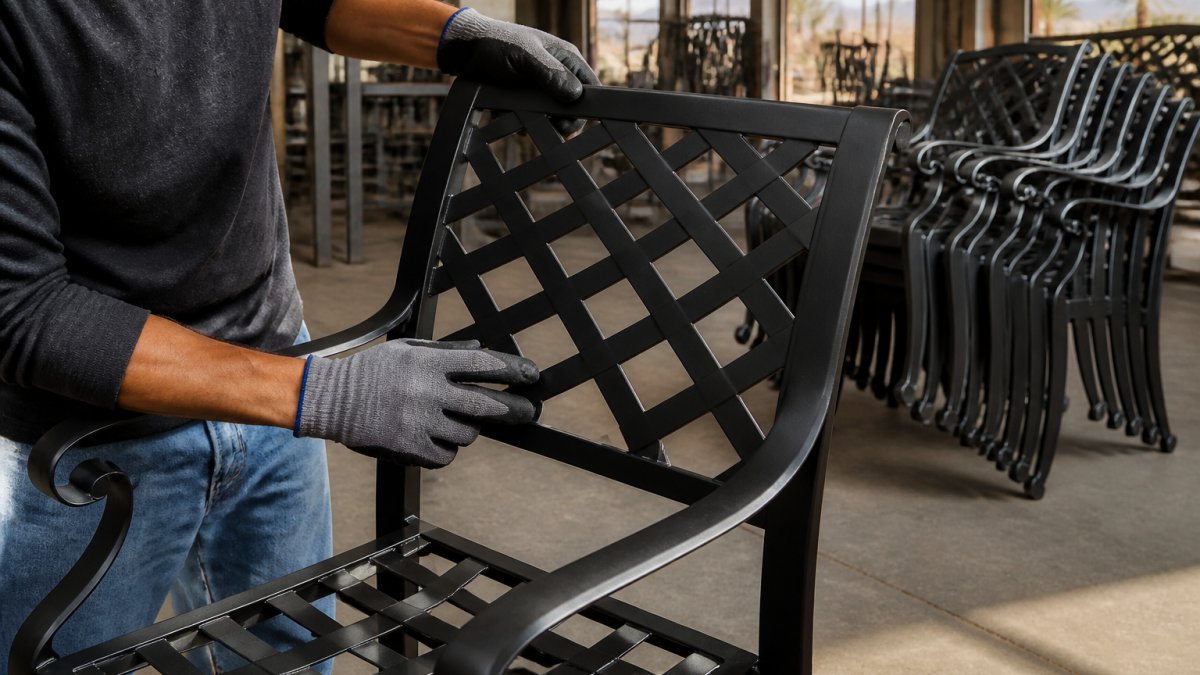
The process matters more than the color card. Proper powder-coated metal outdoor furniture goes through cleaning, sometimes sandblasting, a primer or conversion coat, then the powder layer and an oven cure.
Ask your fabricator two questions: what prep happens before coating, and what the cure temperature is. Vague answers are a red flag.
Finish durability is a process question, not a color question. The prep work you can’t see determines how the finish you can see performs.
Custom Metal Patio Furniture Built to Your Dimensions
Custom metal patio furniture is built from your measurements, so odd-shaped patios, low overhangs, and tight stairwells stop being obstacles.
The process starts with accurate dimensions: length, width, height clearance, and access route. The fabricator produces a drawing, you approve it, and production begins.
This is where stock furniture fails most often. You end up working around the piece instead of the piece working around your space.
Custom Outdoor Tables and Benches for Homes, Condos, and Hospitality
Custom outdoor tables and benches serve three very different buyers: homeowners fitting a single patio, property managers furnishing a whole complex, and hospitality operators needing furniture that survives daily commercial use.
For condo complexes, the priority is consistency and low maintenance across many identical units. For restaurants and hotels, it’s heavy-duty construction and finishes that handle constant cleaning.
Production volume changes the conversation. A single custom table is a design project.
How to Vet Metal Patio Furniture Manufacturers Before You Order
Vet metal patio furniture manufacturers on four things: documented warranty terms, finish process, fabrication standards, and a real installation plan. Get the warranty in writing and read what it covers.
A warranty is only useful if the claim process is clear. Ask who you call, what proof is required, and how long a resolution takes.
Fabrication standards matter too. Ask how welds are inspected, whether frames are jig-built for consistency, and what happens if a piece arrives damaged. Reputable fabricators answer these without flinching.
Request a written warranty summary and a sample of the finish on a small metal offcut. Both take minutes to provide and tell you a lot about how the business operates.
Pricing, Timelines, and What Drives the Quote
Most fabricator pages stop at “request a quote,” leaving buyers without a way to sanity-check a number or plan a schedule. Below: how custom metal outdoor furniture pricing is structured, what moves the number, and how lead times and delivery work.
How a custom metal furniture quote is structured
A well-built quote breaks into five line items. Ask for them separately so you can compare providers on the same basis.
| Line item | What it covers | What moves it |
|---|---|---|
| Design and engineering | Drawing review, dimensioned drawings, approval revisions | Number of revisions, complexity of geometry, site-survey needs |
| Material | Metal type, alloy, thickness, and yield | Alloy choice, gauge, waste factor, market metal pricing |
| Fabrication labor | Cutting, forming, welding, jig setup, assembly | Weld inches, curve count, custom joinery, setup time per unique piece |
| Finish | Prep, primer or conversion coat, powder coat, cure | Prep steps, coating system, color changes, masking |
| Delivery and installation | Freight, crating, site access, install labor | Distance, piece size, stair or elevator access, install complexity |
A quote that collapses all five into one number is harder to compare and audit. Ask for the breakdown.
The cost drivers, ranked by impact
The biggest swings come from a short list of variables:
- Material choice. Stainless steel typically carries the highest material cost of the three common outdoor metals, aluminum sits in the middle, and carbon steel is usually the lowest, but carbon steel needs a protective finish to survive outdoors, which shifts cost to the finish line.
- Design complexity. Straight frames with square joins are the fastest to build. Curves, compound angles, custom joinery, and hidden fasteners add fabrication time and setup.
- Finish specification. A standard single-color powder coat is the baseline. Multi-step prep, specialty coatings, custom color matching, and two-tone masking add cost.
When you compare quotes, ask each provider to price the same drawing revision and the same finish system. A lower number on a different scope is not a lower price, it is a different project.
Timelines: what to expect and what to plan for
Custom work takes longer than stock and usually breaks into four phases:
- Design and approval. Drawing review and sign-off. This phase is often the longest source of delay because it depends on buyer feedback.
- Material procurement. Standard alloys and thicknesses are usually in stock; specialty alloys or unusual gauges may need to be ordered.
- Fabrication and finishing. Cutting, welding, prep, coating, and cure. Cure schedules in particular cannot be rushed without risking finish performance.
- Delivery and installation. Freight scheduling plus site access and install time.
Ask for a written production schedule with milestone dates at quote stage. A provider who can’t give milestones before you sign is unlikely to give updates after.
Delivery and installation mechanics
Delivery terms vary more than buyers expect. Common options are curbside freight, room-of-choice delivery, and full installation. Each has different requirements:
- Curbside freight requires you to move the pieces from the truck. Confirm whether a liftgate is included and who is responsible for unloading.
- Room-of-choice delivery requires a clear path and usually a signed damage inspection at the door.
- Full installation requires the fabricator to review site access in advance, gate width, stair turns, elevator dimensions, and surface conditions.
For multi-unit properties, installation scheduling often must be coordinated with other trades. Build that into the timeline rather than treating it as an afterthought.
How to compare quotes without getting burned
Use a simple checklist before you sign:
- Same drawing revision on every quote
- Same metal, alloy, and thickness
- Same finish system and prep steps
If a provider will not put those items in writing, that is your answer.
Pricing transparency is a process question. A provider who can break a quote into design, material, labor, finish, and delivery is usually the one who can also explain what happens if something goes wrong.
Frequently Asked Questions
What does custom metal outdoor furniture fabrication include?
Fabrication covers the full path from design to delivery: design assistance and shop drawings, material selection (steel, stainless steel, or aluminum), cutting, welding, and assembly, then protective finishing such as powder coating. Many providers also handle delivery and installation. For a custom metal outdoor furniture project, confirm in writing which steps are included, whether engineering drawings are provided, and who handles on-site installation, since scope varies widely between fabricators.
Which metals are best for outdoor furniture in intense sun and heat?
Aluminum resists rust best and stays lighter, which suits large tables and seating that gets moved. Powder-coated steel offers strength for benches and structural pieces at a lower material cost, but any chip in the coating exposes steel to moisture. Stainless steel delivers the highest corrosion resistance for coastal or high-humidity settings. For desert climates, aluminum with a quality powder coat and stainless hardware is a common combination for custom metal patio furniture that lasts.
How do you protect metal patio furniture from rust?
The coating does most of the work. Powder coating forms a bonded shell that resists UV fading and moisture far better than paint, and stainless steel fasteners prevent rust bleeding at joints. Touch up chips promptly, keep frames draining rather than pooling water, and rinse off dust buildup seasonally. Ask metal patio furniture manufacturers what pretreatment the frame receives before coating, because surface prep determines how long the finish holds.
How long does custom fabrication and delivery take?
Timelines depend on design complexity, production volume, and finish selection. Simple pieces from a standard catalog often ship faster than fully custom designs, which require drawings and approval before production begins. Ask for a written schedule covering design approval, fabrication, finishing, and delivery, and confirm whether installation is scheduled separately. Get the lead time in the quote so warehouse delays do not surprise you.

