
Table of Contents
- Why Condo Outdoor Furniture Fails (and What Lasts)
- Commercial-Grade Outdoor Furniture: What the Label Actually Means
- Commercial Apartment Patio Furniture: Sizing Pieces for Balconies and Courtyards
- Commercial Patio Furniture for HOA Pools: Chaise Lounges, In-Water Chairs, and Shade
- Materials by Climate and Exposure: Aluminum, Resin Wicker, and Vinyl Strap
- Lifecycle Cost and Total Cost of Ownership for Shared Amenities
- Your Commercial Outdoor Furniture Buying Guide: Procurement, Safety, and Installation
- Frequently Asked Questions
Last Updated: October 17, 2026
Why Condo Outdoor Furniture Fails (and What Lasts)
Most commercial outdoor furniture for condo complexes doesn’t fail because residents are careless. It fails because the pieces were never built for the conditions a condo property actually creates. Commercial outdoor furniture for condo complexes has to survive full-day sun, monsoon rain, chlorinated splash zones, and dozens of residents using the same chair every week. At Molino Patio, we’ve spent over 30 years building furnishings for exactly this kind of exposure, and the pattern is consistent: residential-grade pieces look good for a season or two, then the frame rusts, the cushions mildew, and the replacement cycle starts over.
The Three Failure Points: Sun, Water, and Heavy Use
Ultraviolet light breaks down cheap finishes and fabric fibers until they chalk, fade, and tear. Water gets into welds, seams, and cushion cores, and trapped moisture does the rest. Heavy use accelerates both: a chair rated for a family of four gets sat in by forty people a day at a condo pool. Commercial-grade construction addresses all three at once, which is why the material spec matters more than the styling.
Commercial-Grade Outdoor Furniture: What the Label Actually Means
Commercial-grade outdoor furniture is furniture engineered and rated for continuous use in shared or public settings rather than occasional residential use. The label should mean a heavier frame gauge, welded rather than bolted joints, solution-dyed fabrics, and finishes tested for sun and moisture exposure.
Here’s what most buying guides miss: “commercial” is not a regulated term. Anyone can print it on a catalog page. Ask for the specifics instead:
- Frame material and wall thickness, not just “aluminum”
- Whether joints are welded or mechanically fastened
- Warranty terms that cover commercial use specifically
A residential warranty often voids the moment furniture is placed in a common area. If the warranty document doesn’t explicitly cover commercial or multi-user settings, you have no coverage on the amenity deck, no matter what the sales sheet says.
Molino Patio builds factory-direct and custom pieces with a lifetime warranty on frames and a five-year warranty on cushions, which is the kind of written coverage to look for.
Commercial Apartment Patio Furniture: Sizing Pieces for Balconies and Courtyards
Commercial apartment patio furniture has to solve a space problem before it solves a style problem. Balconies with low overhangs and L-shaped courtyards punish standard sets, so measure first and shop second.
A practical approach:
- Map every outdoor zone, from individual balconies to the shared courtyard
- Record depth, width, and overhead clearance at each zone
- Choose bistro and two-seat configurations for balconies
- Reserve full dining sets and lounge groupings for courtyards
- Confirm walkway clearance before ordering anything
Custom-built pieces matter here. Odd angles and tight overhangs are exactly where stock inventory lets property managers down.
Commercial Patio Furniture for HOA Pools: Chaise Lounges, In-Water Chairs, and Shade
Pool decks are the hardest-working square footage on the property. Commercial patio furniture for HOA pools needs chaise lounges with reinforced frames, in-water chairs rated for chlorine exposure, and shade structures that hold up to wind.
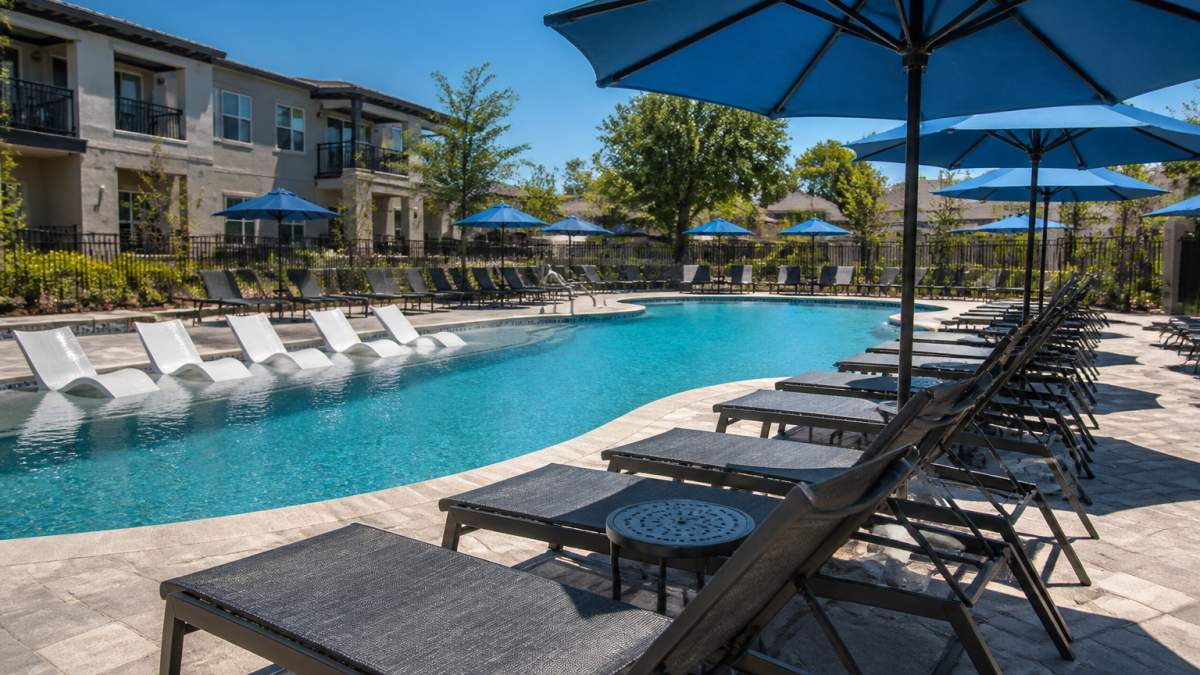
Chaise Lounges: Frame, Strap, and Wheel Specs
A pool chaise takes more abuse than any other piece on the property. Look for a frame wall thickness of at least 1.2 mm on aluminum, welded cross-braces at the hinge points, and a weight rating that accounts for a resident plus a wet towel and a cooler. Vinyl strap seating dries fast and resists chlorine better than most woven options, but strap width matters: 2-inch straps distribute weight and resist sagging far better than 1-inch straps.
In-Water Chairs: Chlorine Chemistry and Hardware
In-water chairs live in the most corrosive environment on the property. Chlorinated water attacks standard steel hardware, so specify 316 stainless steel or marine-grade aluminum for any submerged or splash-zone component. The chair’s frame should be a single welded unit rather than bolted sections, because bolts loosen under the constant flex of water movement. Drainage holes in the seat and back prevent standing water and reduce algae growth.
Shade Structures and Umbrellas: Wind Ratings and Anchoring
Umbrellas need weighted bases and wind-rated canopies, because a loose umbrella in a gust becomes a liability claim. Look for a canopy rated to a specific wind speed, many commercial umbrellas carry a rating in the 30-50 mph range, and pair it with a base weight appropriate to the exposure. On an open pool deck, a base filled with sand or water is the minimum; in a windy corridor, an in-ground anchor or a heavy steel plate is safer.
Spares, Storage, and Seasonal Rotation
Order spares for the highest-traffic pieces so a single failure doesn’t leave a gap on the deck. A practical rule is to keep one spare chaise and one spare umbrella canopy per 20 units. Off-season storage matters too: stack chaises in a dry area, remove cushions, and store umbrellas closed and covered. A rotation plan that moves older pieces to lower-traffic zones extends the life of the whole inventory without a full replacement.
Materials by Climate and Exposure: Aluminum, Resin Wicker, and Vinyl Strap
Material selection should follow exposure, not trend. Extruded aluminum is the default for frames: light enough to move, strong enough for daily shared use, and naturally rust-resistant. Resin wicker gives the woven look without the rot that natural wicker suffers in wet conditions. Vinyl strap is the pool-deck workhorse, drying quickly and standing up to chlorine and sun.
For full-sun exposures, powder-coated finishes and solution-dyed fabrics hold color far longer than painted or piece-dyed alternatives. In shaded courtyards, you have more freedom, but water drainage still decides how long cushions last.
Specify drainage-friendly cushion cores and removable covers for any piece that lives outdoors year-round. It’s the difference between a cushion that dries by evening and one that smells like a wet basement by August.
Lifecycle Cost and Total Cost of Ownership for Shared Amenities
The cheapest set is rarely the cheapest decision. Total cost of ownership combines purchase price, replacement frequency, maintenance hours, and downtime on the amenity. A lower-priced chair replaced every third season usually costs more than a commercial-grade chair that lasts a decade.
Build a simple comparison before you buy:
| Cost Factor | Budget Furniture | Commercial-Grade Furniture |
|---|---|---|
| Purchase price | Lower upfront | Higher upfront |
| Replacement cycle | Frequent | Infrequent |
| Maintenance hours | Higher | Lower |
| Warranty coverage | Often void in shared use | Written for commercial use |
| Resident satisfaction | Drops with wear | Stays consistent |
Pricing depends on quantity, materials, and delivery, so request a current quote rather than budgeting from a catalog guess. Financing options can also spread the upfront cost across a budget cycle.
Your Commercial Outdoor Furniture Buying Guide: Procurement, Safety, and Installation
A commercial outdoor furniture buying guide should start with the property management workflow, not the catalog. Procurement for shared amenities runs through board approval, budget cycles, and delivery scheduling, and skipping those steps causes most project delays.
Step 1: Define Zones and Build a Materials Spec
Walk the property and map every outdoor zone, from individual balconies to the shared courtyard and pool deck. Record depth, width, and overhead clearance at each zone. Then set a materials spec by exposure: full-sun areas need powder-coated aluminum and solution-dyed fabrics; pool decks need vinyl strap and 316 stainless hardware; shaded courtyards can use resin wicker with drainage-friendly cushions.
Step 2: Confirm Warranty Terms Cover Commercial Use
Before any order, read the warranty document, not the sales sheet. Confirm that the warranty explicitly covers commercial or multi-user settings, that frame and cushion coverage are stated separately, and that replacement parts are available. A lifetime frame warranty with a five-year cushion warranty is a common benchmark for commercial-grade pieces. If the warranty voids in shared use, the piece is residential furniture with a commercial label.
Step 3: Order Samples and Evaluate in Place
Order a sample chair and leave it on the deck for a full season if the timeline allows. Check how the finish holds up to sun, how the cushion drains after rain, and how the frame feels under daily use. Samples also give the board something tangible to approve, which shortens the approval cycle.
Step 4: Get Board or HOA Approval on the Budget
Procurement for shared amenities runs through board approval and budget cycles. Present the materials spec, the warranty terms, and a lifecycle cost comparison, not just a purchase price. Boards respond to total cost of ownership: a lower-priced chair replaced every third season usually costs more than a commercial-grade chair that lasts a decade. Financing options can spread the upfront cost across a budget cycle.
Step 5: Plan Delivery, Installation, and Anchoring
Schedule delivery around resident disruption. Confirm walkway widths and accessibility before anything arrives; furniture must not block accessible routes, and shade structures and umbrellas need proper anchoring. For reference on accessible routes and clear floor space, review the ADA Standards for Accessible Design. On the procurement side, the U.S. General Services Administration publishes guidance on buying durable furnishings for shared facilities, and the Consumer Product Safety Commission maintains recall and safety information worth checking before any large order.
Step 6: Set a Seasonal Maintenance Calendar
A maintenance calendar is part of procurement, not an afterthought. Schedule cleaning and inspection at the start and end of each season: check welds, tighten hardware, inspect straps and cushions, and test umbrella anchors.
Molino Patio handles delivery and installation across Arizona and works with property managers on bulk orders for complexes of any size, including small communities of around twenty units.
The strongest buying decision is a written one: a materials spec, a warranty that covers commercial use, and an installation plan. Everything else is styling.
Frequently Asked Questions
What is the best commercial-grade outdoor furniture for condo complexes?
The best condo outdoor furniture balances durability, comfort, and repairability. Extruded aluminum frames with powder coating resist rust and hold up in intense sun. Resin wicker and vinyl strap seating handle poolside moisture and heavy traffic. Look for frames with a lifetime warranty and cushions with a multi-year warranty, plus pieces that can be re-strapped or reupholstered rather than replaced. Specify commercial-grade construction rated for shared amenities, not residential furniture, so pieces survive daily use across many residents.
How do you choose commercial apartment patio furniture for small balconies?
Measure the usable depth first, then choose compact bistro sets, stacking chairs, and folding tables that fit without blocking walkways. Commercial apartment patio furniture should be sized to the smallest balcony in the community, not the largest. Pick pieces with slim profiles, stackable or nestable designs for storage, and materials that resist fading on west-facing exposures. Confirm weight limits and wind ratings before ordering, since upper-floor balconies catch more wind than ground-level courtyards.
What outdoor furniture works best around a condo pool?
Poolside pieces need chlorine and moisture resistance. Chaise lounges with aluminum frames and quick-dry sling or vinyl strap seating work well, and in-water chairs let residents cool off without leaving the pool. Add shade umbrellas with weighted bases rated for wind, plus side tables that drain rainwater. Avoid untreated steel and solid wood near the water. Specify commercial patio furniture for HOA pools that can be hosed down and that dries fast to prevent mold and mildew between uses.
What materials hold up best in intense sun and frequent use?
Extruded aluminum, resin wicker, and vinyl strap are the workhorses for sun-heavy climates. Powder-coated aluminum resists rust and does not fade like painted steel. Resin wicker handles UV exposure without cracking when it is commercial-grade. Vinyl strap seating dries quickly and can be re-strapped on site when it wears. Solution-dyed acrylic cushions hold color longer than standard fabrics. Matching materials across tables, chairs, and lounges keeps the community looking consistent and simplifies replacement part orders.
How should condo associations maintain commercial outdoor furniture?
Set a simple schedule: wipe frames and straps monthly, rinse poolside pieces weekly during swim season, and inspect hardware and welds each quarter. Store or cover cushions during off-season or monsoon periods. Keep a small inventory of replacement straps, glides, and cushion covers so minor wear does not turn into full replacement. A written maintenance log helps the board track lifecycle costs and justify budget requests. Repairable furniture with replaceable parts keeps shared amenities looking good for years.
How much outdoor seating should a condo community provide?
Plan seating around the amenity, not the unit count alone. Pool decks typically need one lounge per two to three residents expected at peak, plus table seating for dining areas and benches along walkways. Courtyards need clustered seating for small groups. Overbuying wastes budget on unused pieces; underbuying causes crowding and complaints. Walk the space with a layout plan, mark traffic paths, and confirm counts with the board before ordering commercial outdoor furniture.
Condo outdoor furniture only pays off when it survives the deck it sits on. If you’re tired of replacing rusted frames and mildewed cushions every few seasons, Molino Patio can help. We offer factory-direct and custom-built commercial outdoor furniture for condo complexes, backed by over 30 years of experience, a lifetime frame warranty, a five-year cushion warranty, and interest-free 90-day financing. Get started with Molino Patio and furnish your shared spaces once, properly.
